Landing validation
Validity and Repeatability of Single-Sensor Loadsol Insoles during Landing
Robin M. Queen, Alexander T. Peebles and Kristen E. Renner.

loadsol application
Use plantar normal force data to guide loading progression, asymmetry correction and return-to-sport decisions.
During sport rehabilitation, clinicians and researchers often need to know how much load an athlete actually accepts through the injured limb. loadsol places force measurement inside the shoe, allowing drills, walking, jogging and sport-specific tasks to be monitored without a fixed force plate.
Real-time visual or acoustic thresholds can help patients stay within target loading zones, while stored force curves allow later comparison of sessions, limbs and exercise conditions. For rehabilitation protocols, loadsol can be selected as a 1-zone total-force sensor, a 2-zone anterior/posterior layout, or a 3-zone regional layout when the study needs more detailed loading behavior.
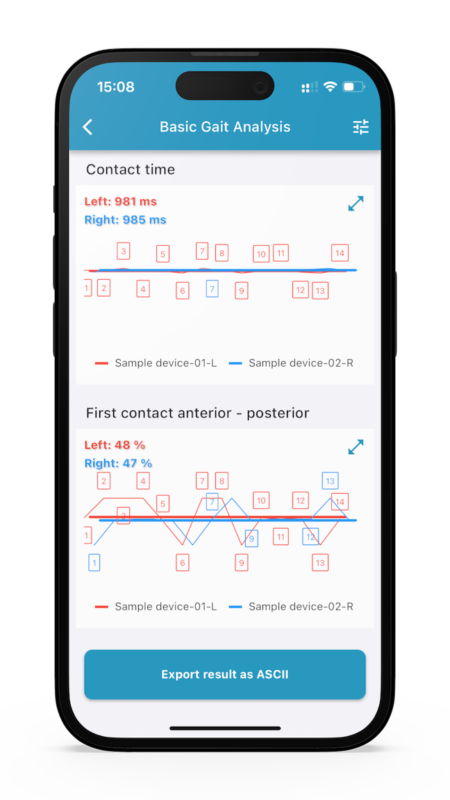
Compare loading symmetry and peak force behavior across functional tests and sport drills.
Use feedback thresholds to train controlled weight bearing during progression phases.
Collect force data outside the laboratory in shoes and environments that match the task.
Expanded application notes
How much load does the athlete accept, when does asymmetry appear, and can feedback keep the exercise inside the target zone?
Peak force, impulse, stance timing, loading-rate changes and left-right symmetry across return-to-sport drills.
Choose the loadsol zone layout before testing: total area, anterior/posterior, or 3-zone regional force. Confirm shoe size, 10 - 200 Hz sampling needs, BLE or USB-C transfer, and whether optional loadsync synchronization is required.
The application becomes stronger when force data is synchronized with video, timing events, questionnaires, motion capture or operator notes.
Video resource
These short videos show practical loadsol examples for sport and rehabilitation .
Research and publications
The most relevant literature for this page focuses on landing kinetics, kinetic symmetry after ACL reconstruction, walking/running reliability and insole feedback for partial weight-bearing control.
Landing validation
Robin M. Queen, Alexander T. Peebles and Kristen E. Renner.
ACLR stop jump
Alexander T. Peebles, Kevin R. Ford, Jeffrey B. Taylor, Joseph M. Hart, Laura P. Sands and Robin M. Queen, 2019.
ACLR gait
Rachel E. Cherelstein, Christopher Kuenze, Matthew S. Harkey, Michelle C. Walaszek, Corey Grozier, Emily R. Brumfield, Jennifer N. Lewis, Garrison A. Hughes and Edward S. Chang, 2025.
Clinical gait
Kristen E. Renner, DS Blaise Williams and Robin M. Queen, 2019.
Biofeedback
Janina Anna Mussig, Andreas Brand, Inga Kroger, Isabella Klopfer-Kramer and Peter Augat, 2022.
Tell us the sport, footwear, movement tasks and force metrics you need.
Flyer


