texsens
Effects of Compression Pants with Different Pressure Levels on Anaerobic Performance and Post-Exercise Physiological Recovery: Randomized Crossover Trial
Qinlong Li, Kaixuan Che, Wenlang Yu, Wenda Song and Yue Zhou, 2025.
Low force under textiles or garment
Calibrated force measurement for soft textile interfaces where low pressure, movement and accuracy are critical.
What is texsens?
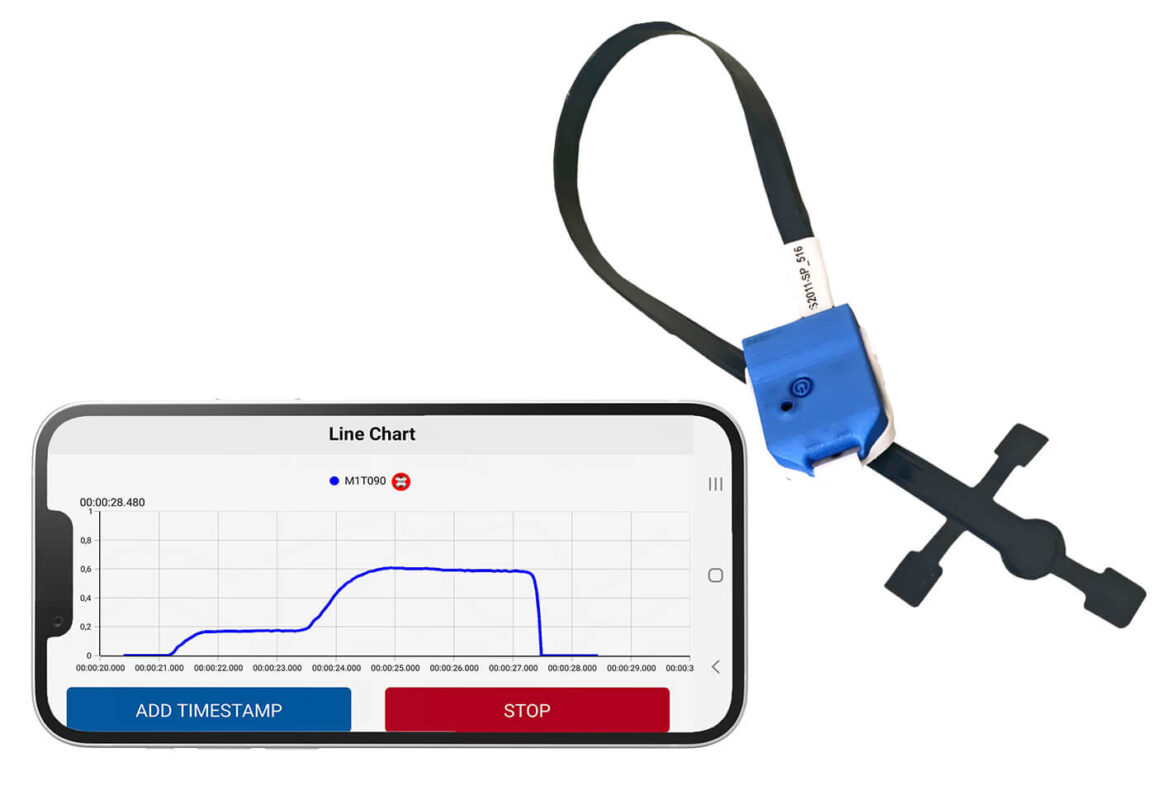
The texsens force measuring device was designed specifically for textile and clothing load measurement. It uses a fully calibrated capacitive sensor connected to small, lightweight loadpad electronics.
In applications where contact pressures are very low and accuracy is crucial, texsens sensors provide a practical solution for measuring force under clothing.

Use cases
Texsens sensors are used when very low contact pressures must be detected during body movement under compression clothing, sportswear, medical textiles or garment prototypes.
Real-time analysis
Data can be stored on the device, transferred to a computer and monitored over time. The mobile app supports force curves and threshold-based audio or visual feedback for repeatable testing.
Applications
Measure local contact load during movement and fit testing.
Evaluate soft supports, braces and therapeutic garment concepts.
Compare panels, seams, straps and material structures under activity.
Measure body-device contact in soft wearable prototypes.
Measurement workflow
texsens is designed for situations where small contact loads matter and the measurement itself must remain unobtrusive. The sensor can be positioned beneath a garment, compression zone or textile prototype to monitor local force while the person moves, breathes, changes posture or performs a sport-specific action.
The resulting curves help teams compare material stiffness, pattern design, compression distribution and fit over time. Because garment comfort and therapeutic performance can depend on subtle local loading, calibrated low-force sensing provides evidence that visual inspection alone cannot deliver.
Local textile load, peak contact force, pressure trend over movement, fit stability, left-right comparison and threshold events.
Use texsens data to refine compression garments, medical textiles, sportswear, braces, straps and wearable prototypes before user discomfort appears.
Scientific context
novel positions texsens for low contact forces under garments, compression clothing and textile structures. The related publication list includes texsens work on compression pants and compression stockings, showing how low-force garment measurement can support performance, recovery and fit analysis.
Garment pressure can influence comfort, recovery and performance, so calibrated low-force data is useful during textile development.
texsens can monitor how local garment load changes as the body moves, which is difficult to judge from static fitting alone.
The texsens product page describes a small, thin sensor for low pressure ranges under clothing with mobile Bluetooth data capture.
texsens
Qinlong Li, Kaixuan Che, Wenlang Yu, Wenda Song and Yue Zhou, 2025.
texsens
Olena Kyzymchuk, Mykola Riabchykov, Yordan Kyosev, Liudmyla Melnyk and Jessika Boll, 2024.
Tell us about the garment, contact area and expected force range.
Flyers
